How our SDE works
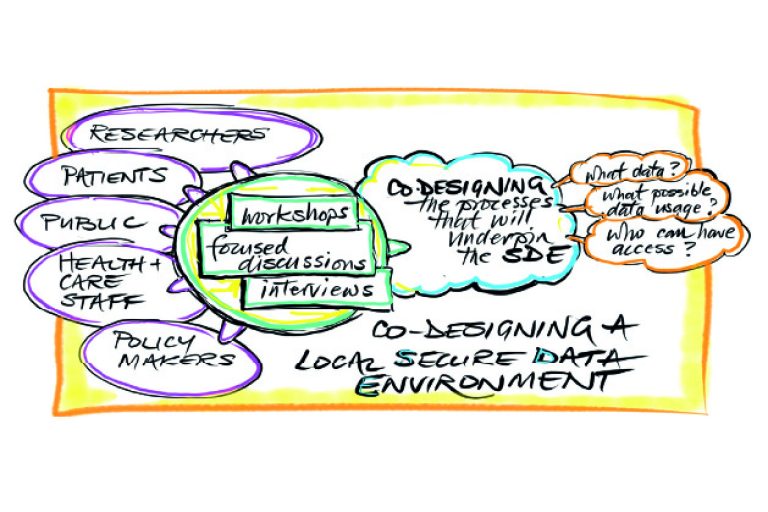
We have from the onset, and will continue to work closely with patients, public and healthcare professionals within the TVS area on the design of our SDE. We will work with the Five Safes Framework.
We have from the onset, and will continue to work closely with patients, public and healthcare professionals within the TVS area on the design of our SDE. We will work with the Five Safes Framework.

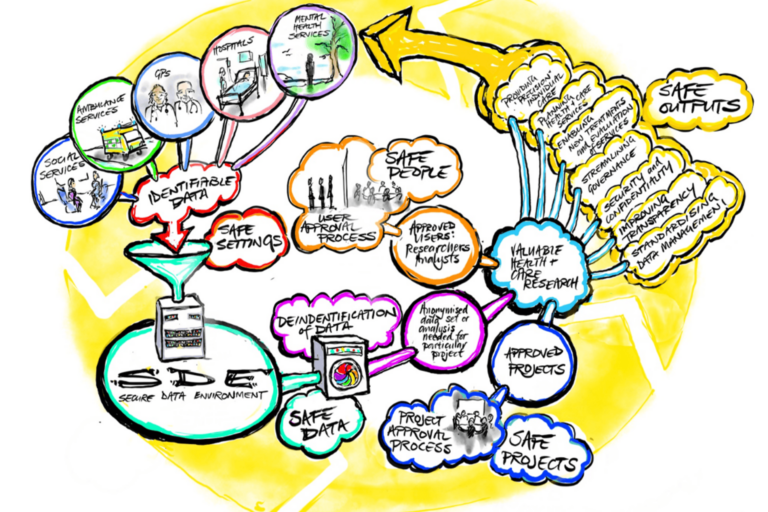
This image was co created with our patient, public and health care professionals, Understanding our Data Community of Practice (CoP – see get involved) to show the data journey for research and planning within the secure data environment. It is explained in more detail below.
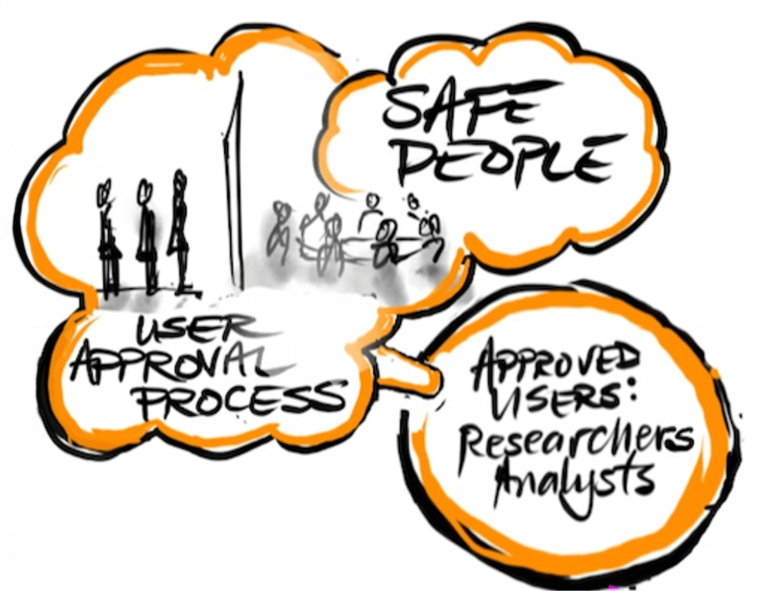
We are developing an approved researcher scheme to ensure that the people that access the SDE data, meet the standards that we co-design with our community of practice.

We are codesigning the criteria and processes that will be used to approve projects and allow researchers to access the SDE data.

Safe data
Patient data will come into the SDE from healthcare organisations from across the Thames Valley and Surrey. When it enters the initial ‘processing environment’ it is checked and de-identified. Minimised extracts of de-identified data are produced for analysis within the ‘trusted research environment.
Safe settings
The data are kept safe in the SDE, researchers are not given a copy to take away. Researchers can analyse the de-identified data within the ‘trusted research environment’, they cannot download it. How the data are used will be monitored.

We are co-designing our value strategy to help ensure that the planned outputs create value for patients, the public and the NHS (see Get Involved).
Why we share data across Secure Data Environments (SDEs)
To support specific research projects that have been approved through rigorous review, our Secure Data Environment (SDE) may share information with other NHS SDEs. This enables researchers to answer important health questions using data from different regions, especially where local data alone may be insufficient (e.g. rare disease research). These collaborations aim to deliver clear public benefit and avoid duplication.
How we protect your privacy
We only share data for projects that have been approved by a Data Access Committee (DAC), which includes patient and public representatives. Before sharing, we remove direct identifiers such as name or NHS number. The data is transferred securely using encrypted systems.
If you have opted out of sharing your data for research and planning, your information will not be included.
Transparency
Each SDE’s Data Use Register will be updated with details of the project, so you can see how data is being used.
Metadata is data that describes other data. To fully understand the meaning of data, first we need to know some further information about its context, known as metadata. It is important to be able to trust where and who the data comes from and how it relates to other data. The TVS SDE uses a metadata catalogue called the Mauro Data Mapper. The Mauro Data Mapper allows approved users to read descriptions of the kinds of data that can be made available for analysis, it does not show the data itself.
This video from the NIHR HIC describes what a metadata catalogue is in more detail.
Find out more about the Thames Valley & Surrey SDE:
Find out more about who is involved in the TVS SDE:
Useful Links: